
Learn SOS in Morse Code Message (Complete Guide)
Have you ever wondered what the most famous globally recognized Morse code is? Though the SOS distress signal is the most widely recognized worldwide. I know how scary it is to be in an emergency situation, desperately needing to send an SOS, yet not knowing the exact pattern. It’s not only frightening but also dangerous, as misinterpreting any single dot or dash can delay help.
Now, no need to worry as you’ve stepped onto the right article. In this article, we’ve explored all the possible aspects of the SOS in Morse code so you can send or interpret the signal without any hitch. From providing you with the history of SOS to guiding you on its meaning and pattern, this guide has got your back. Whether you’re a researcher or a survivalist looking to practice the SOS signal, this guide is your cream of the crop. So, without waiting time, let’s dive in!
What is SOS in Morse Code?
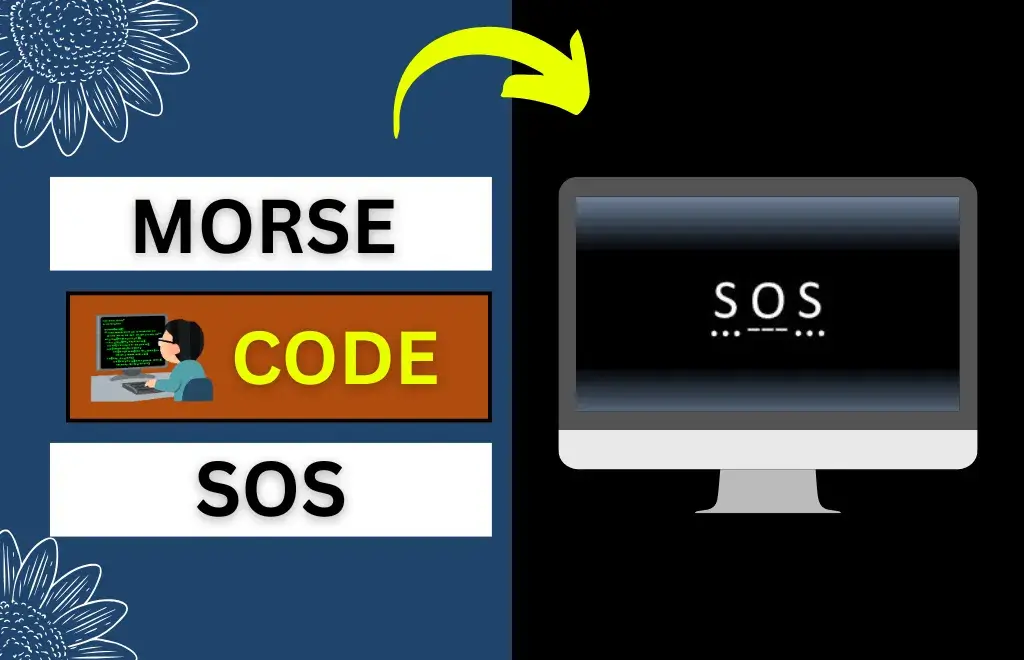
The SOS message is an international Morse code distress signal recognized worldwide and used to request immediate assistance in emergencies, including plane crashes, shipwrecks, and other critical situations. It was established for maritime use, where it operates through the on/off keying of a wireless transmitter. In formal notation, the famous Morse code SOS is written with an overscore line S̅O̅S̅.
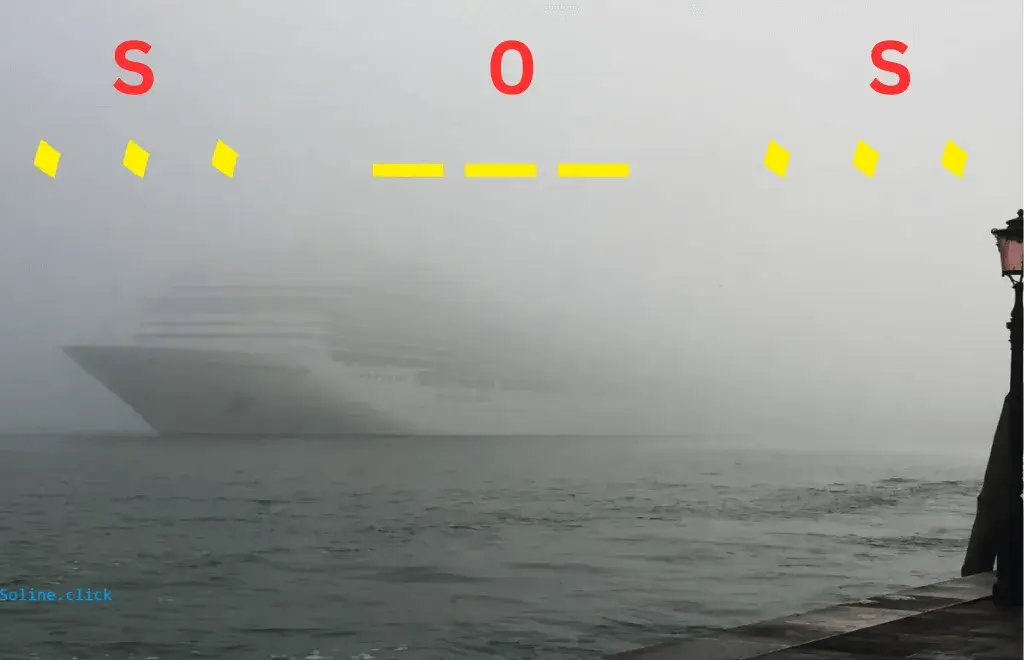
In international Morse code, the SOS is indicated with three short taps, three long taps, and three short taps again, with no space between the letters, just like this (· · · — — — · · ·). The three dots show the letter S, while the three long dashes represent the letter O, making it very easy to remember. In Morse code, it can be pronounced with di-di-dit dah-dah-dah di-di-dit, keeping in mind that the final dot of a letter in Morse code is pronounced by dit instead of di. Furthermore, it doesn’t stand for “Save Our Ship” or “Save Our Souls,” which is a common misconception.
History of SOS
The German government first introduced the SOS in maritime radio regulations on 1 April 1905. Later, it became a worldwide standard when the first International Radiotelegraph Convention, held in Berlin, included it in the service regulations signed on 3 November 1906, and took effect on 1 July 1908. It remained the maritime radio distress signal until 1999, then was replaced by the Global Maritime Distress and Safety System, which is more effective for emergency communications.
The SOS was not the first distress signal; the CQD was initially used by the Marconi company, but it was difficult for the rescue team to understand, causing delays in receiving help. If you want to know the Morse code pattern of CQD, you can use our Morse code translator. Furthermore, it was not an abbreviation initially, but it’s now recognized as a prosign.
What Does SOS Sound Like and How to Learn it?
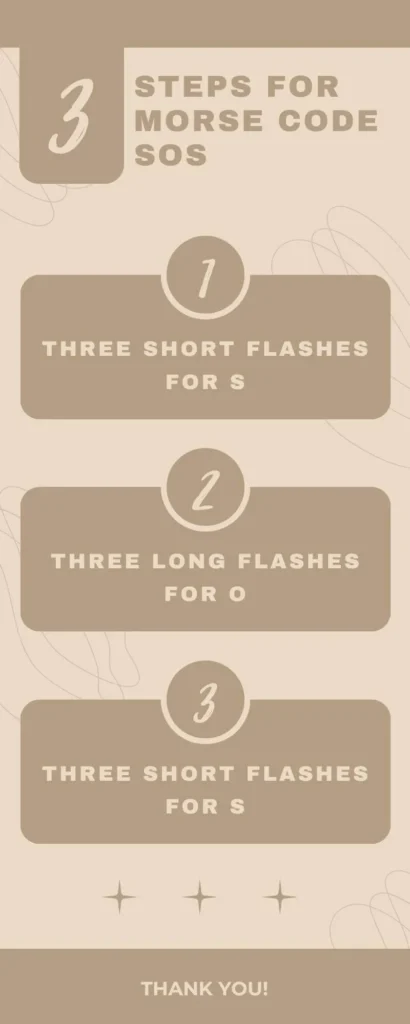
The SOS is straightforward to learn. You just have to remember the basic pattern of three dots or dits that represent the letter S, three dashes or dahs that represent the letter O, and then three dots again that represent the letter S, which makes the word SOS. You can practice SOS signals via tapping, knocking, whistle blasts, and light flashes.
- S = Three dots or dits (· · ·)
- O = Three dashes or dahs (—)
- S = Three dots or dits (· · ·)
The sound of the SOS signal is very distinctive as the duration of a short signal is very quick, while a long signal is three times longer than a short beep signal. Here is the original sound of the Morse code SOS signal:
Why & When to Use the SOS Help Signal?
The primary purpose of sending an SOS signal is to call for immediate help in emergency situations. Before going ahead, keep in mind that the SOS signal should only be used when somebody’s life is at risk and immediate assistance is needed to save their life. In the USA, sending a false signal is a crime under the federal offense of 47 U.S. Code § 325, which may result in a fine of over $10,000 or up to 1 year in prison. Here are some possible situations where it can play an important role:
- Critical emergencies: Transmit this signal when somebody is in immediate danger.
- Medical emergencies: Use when medical assistance is required.
- Natural disasters: You can transmit this signal during floods, earthquakes, and other natural disasters.
- Stranded situations: In situations where you’re lost and no other communication is available.
- Critical equipment failures: Transmit this signal in situations where essential systems of a ship or aircraft fail.
How to Send SOS in Morse Code Effectively
You can become a pro at sending the SOS Morse code signals by following the tips below:
- Learn the SOS pattern of three dots, three dashes, and three dots.
- Practice rhythm and timing to maintain even spacing. Follow the correct ratio of 1:3:7 to get your message across, which is 1 second for a short pause, 3 seconds for a slightly longer pause, and 7 seconds for a full pause.
- Practice regularly at a slow pace first, and then gradually increase the speed.
- Test your skill by translating the message without referring to the pattern.
Other Ways to Send an SOS Message
Morse code is mainly used with radio transmissions. However, the SOS can also be sent through various methods as long as you’re keeping the same pattern of dots and dashes. Below are all the possible methods:
- Flashlights: You can use a flashlight by turning it on and off in the same pattern as the dots and dashes, which is three quick bursts, three long flashes, and then again three quick bursts. It’s helpful to ask for help at night.
- Blow Whistles: Whistling can also be another option, which is helpful in outdoor situations when you have an accident while exploring a remote area.
- Radio: The most standard way to send a Morse pattern of short and long tones is a continuous wave CW frequency.
- Visual Appearances: You can arrange rocks, branches, or other objects in the same SOS pattern (…—…). Not only that, you can also write the pattern in snow, sand, or chalk.
- Body movement or flags: You can mimic the SOS pattern of dot-dot-dot, dash-dash-dash, dot-dot-dot by moving your arms or flags. It’s helpful in situations where visibility is clear but there is no sound.
FAQs
Conclusion
Before I end this article, I just want to say that SOS in Morse code is a signal that everyone should know, as it’s a lifesaver in emergencies. It’s also known as a prosign in Morse code and can be transmitted in various ways, including tapping, knocking, whistling, and others. Introduced by the German government in the Maritime Radio Regulations on 1 April 1905, it consists of three dots, three dashes, and three dots again (· · · — — — · · ·), making it very easy to memorize.
