
Morse Code Keys, Bugs, Paddles, Sounders, and Keyers
Are you a beginner, wondering which Morse key is suitable for starting? You’ve come to the right place. I know how it feels when you want to send a text message in Morse code using keys, but aren’t sure which one to choose, as different types of keys not only confuse you but also slow down your progress.
Now, this problem is going to vanish, as in this article, we’ve explored all the nitty-gritty of Morse code keys to help you pick the best key for yourself. From giving you the types of keys to providing a detailed overview of each, this guide has got your back. Doesn’t matter whether you’re a beginner or a professional operator; at the end of this guide, you’ll be able to pick the suitable key for yourself.
Types of Morse Code Keys
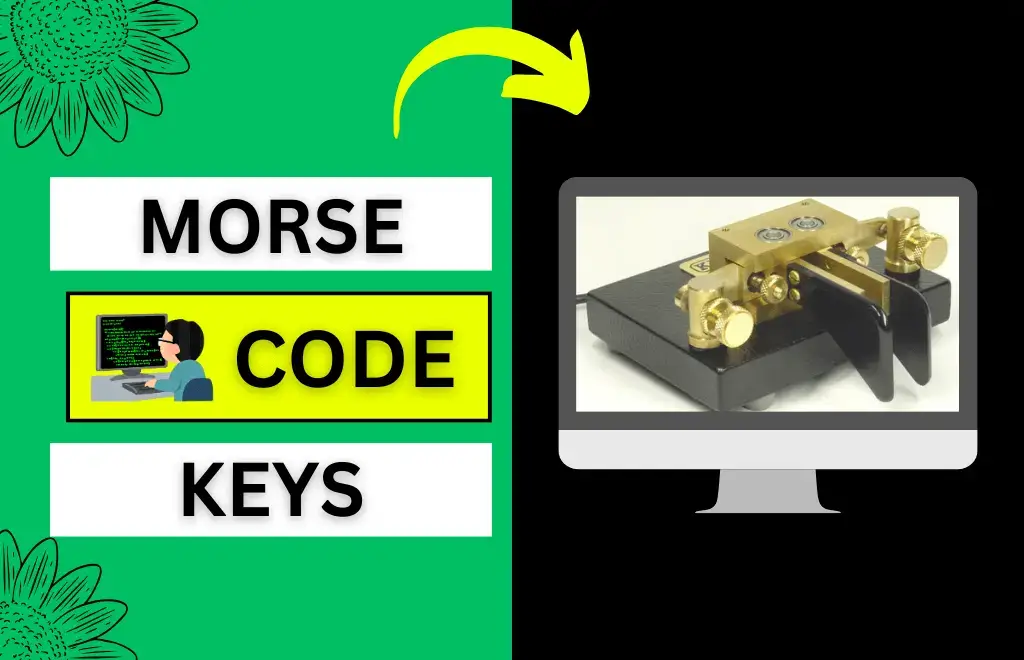
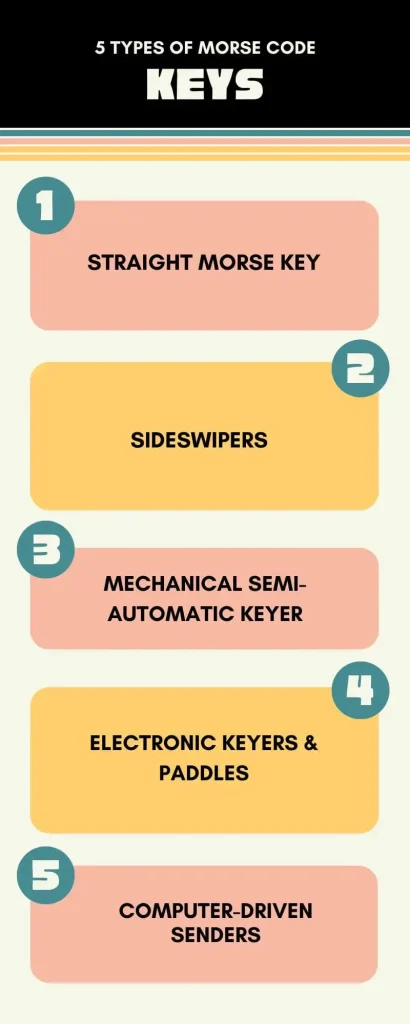
There are various types of Morse keys available for sending CW Morse code and for other radio communication activities. We’ve provided all of the categories below in which the keys and keyers fall:
- Straight Morse key
- Sideswipers
- Mechanical semi-automatic keyer
- Electronic keyers & paddles
- Computer-driven senders
Electromechanical Keys and Sounders
Although all the Morse keys are mechanical, the keys described below are those that can be connected directly to the telegraph or radio circuit, and those that require supporting electronics.
Straight Key
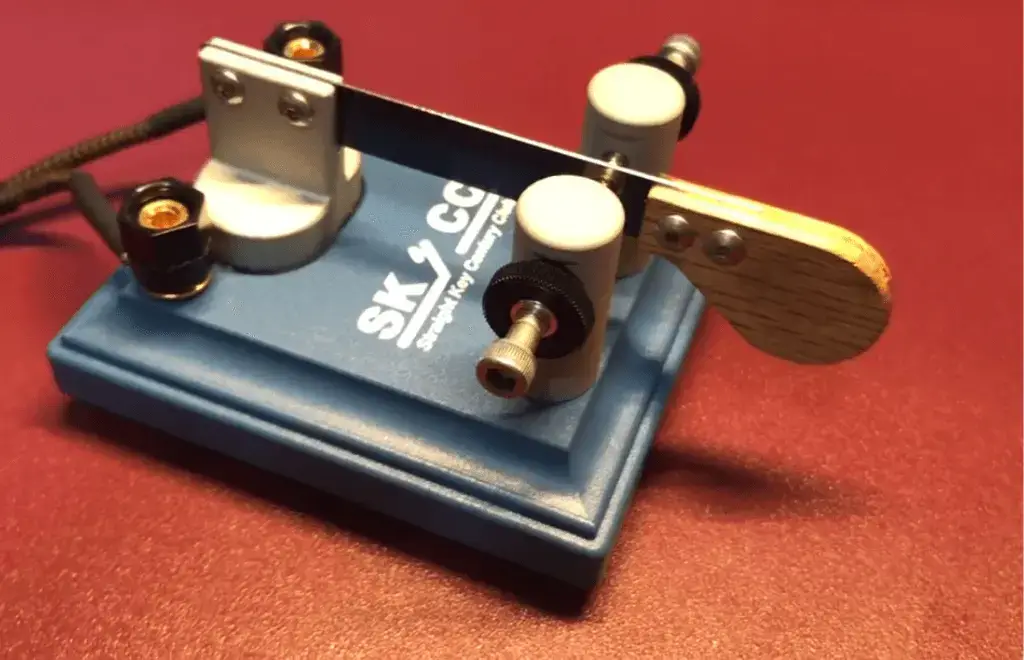
The straight key, also known as the pump handle key, is the simplest, oldest, and most traditional method of sending Morse code used in early telegraphs. It’s the electromechanical switch with a big lever that moves up and down to create dots and dashes of Morse code. The switch is on at rest but closes as soon as it’s pressed.
The straight key can be wired directly to the radio transmitter, and the operator controls the timing of Morse code. While the up-and-down motion of the lever is simple, prolonged use can cause a strain injury known as “glass arm,” which is why recent keys now work in side-to-side motion.
Cootie or Sideswiper
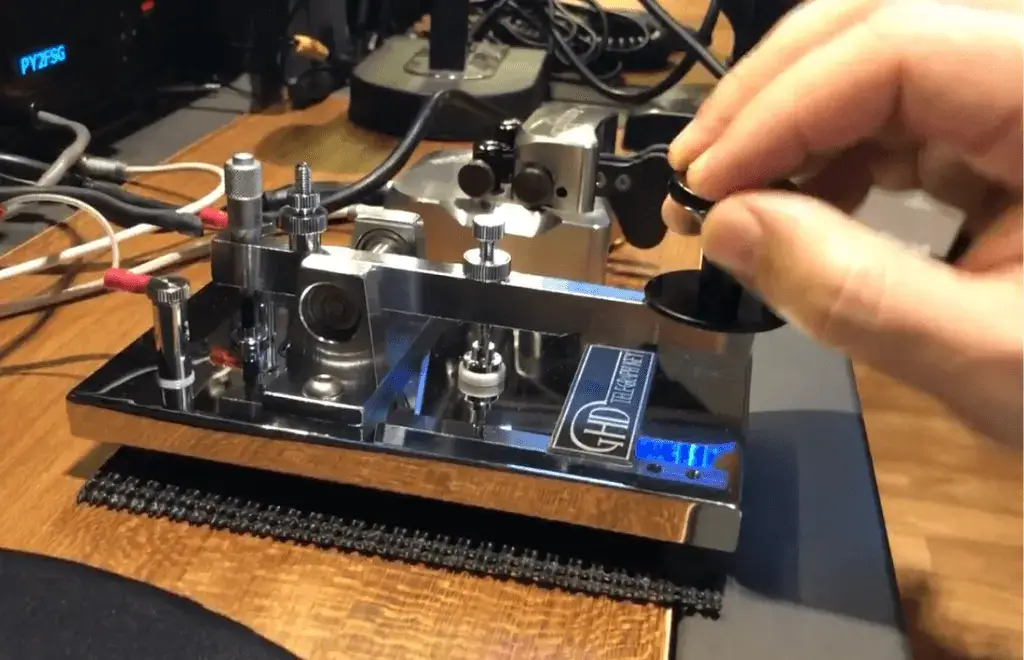
The sideswiper, or sidewinder, also known as a cootie key or bushwhacker, is another electromechanical key designed to prevent repetitive strain injury, also known as glass arm. It’s a straight key but works in side-to-side motion. The transmitter is at rest when the lever is in the middle, but as soon as the lever is pushed left or right, the transmitter comes on and starts manually creating dots and dashes of Morse code.
Just like a straight key, the timing of Morse code is entirely controlled by the operator. Sideswiper can be wired directly and has no electronics. Although it sends the message quickly, it’s rarely seen and is no longer manufactured.
Bug or Semi-Automatic Key
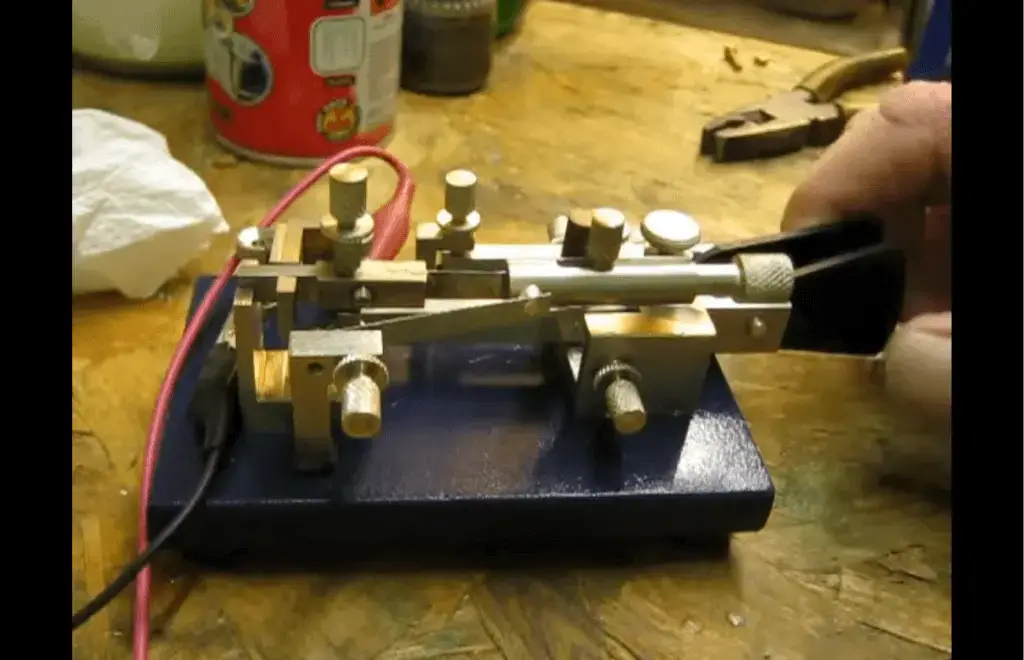
The bug or semi-automatic key, also known as the Vibroplex, is a complex electromechanical key that helps the operator send a well-formed stream of dits. It contains a paddle connected to an arm. When the bug is pushed left, it acts as a manual key, just like a cootie, creating dahs manually, but when pushed right, it behaves like a vibrating device, creating repeated dits with intra-character spacing.
The timing of the dashes is under the operator’s complete control. The bug completes the same circuit and can be wired directly into the transmitter. It’s designed to send Morse code more easily and quickly. Although it’s a complex key, with little practice, you can easily get used to it.
Sounder
A telegraph sounder is an electronic device developed by Alfred Vail in 1850 and used as a receiver for sending Morse code over telegraph wire. It’s used with American Morse code and a straight key, and converts the electricity pulses coming from the wire into an audible sound. The sound is a mechanical click and a clunk, not an electronic beep.
The sounder works by using an electromagnet to pull down a spring-loaded metal bar when current is applied. When the current is stopped, the bar releases and makes a clunk sound. It’s mounted on the same base known as “key on base”.
Electronic Morse Code Keys and Keyers
The keys described below may not necessarily be electronic but require electronics to work.
Single-Lever Paddle
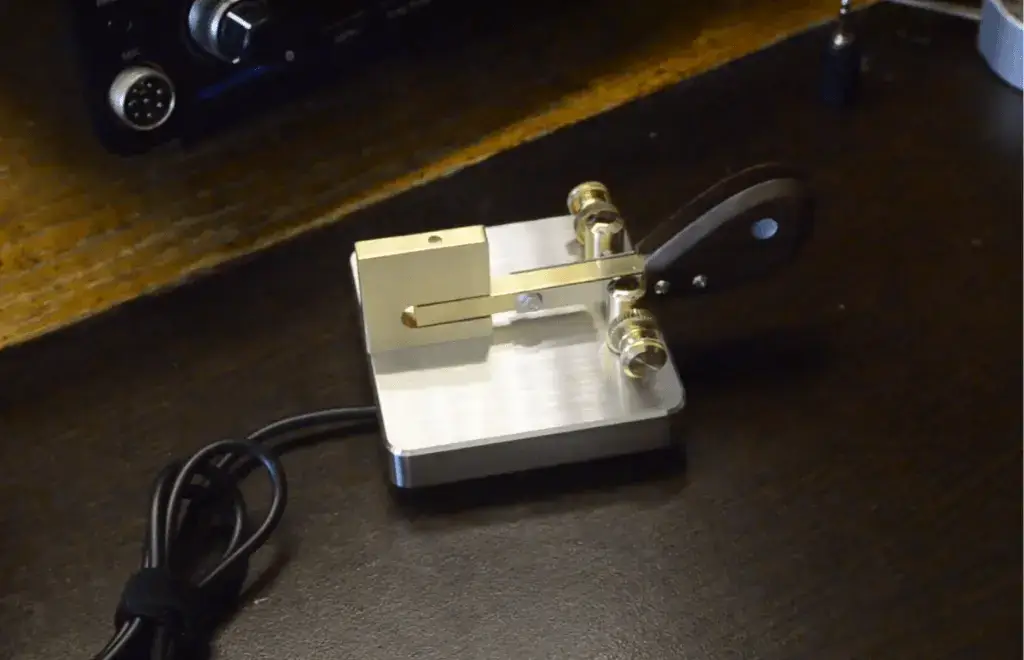
The single-lever paddle is a modern electronic bug similar to a cootie, but it has only one paddle, which is a pair of 2 separate switches. Each switch can be pushed horizontally in a right-to-left motion so that strain injury won’t be a problem. The operator places their thumb and finger between the pedal so they can easily move it to one side or the other. Keep in mind that both sides cannot be closed simultaneously.
The single-lever paddle doesn’t wire directly to a transmitter; it’s wired to a keyer that uses electronics to automatically generate a series of dots and dashes. The automatic making of dots and dashes increases the speed of sending Morse code messages.
Dual-Lever Paddle
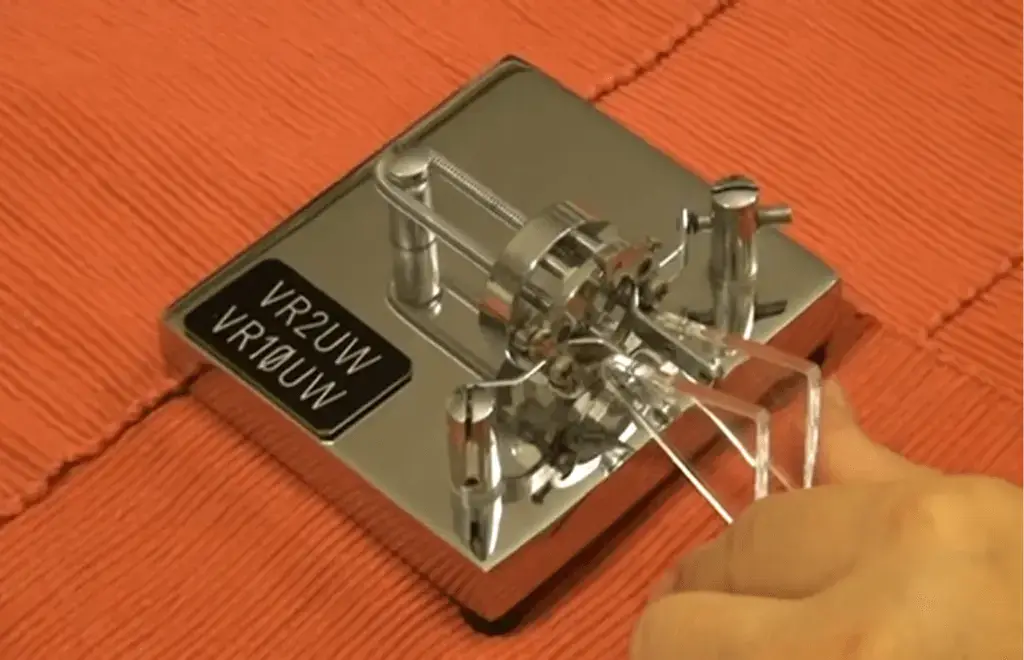
The dual-lever paddle, also known as the squeeze key or iambic key, offers two paddles positioned right next to each other and operates a separate switch. One paddle is for dits and the other for dahs. The operator sets the paddle between their thumb and finger, and when pushed to the right, the left paddle moves to the right. When pushed to the left, the right paddle moves to the left.
The dual-lever paddle is similar to the single-lever paddle when wired to a keyer, but what sets it apart is that both paddles can be squeezed together horizontally or operated individually. It not only prevents strain injury but also increases speed. Moreover, the sequence begins with whichever lever is contacted first. These keys are now very popular, and the majority of the Morse keys are dual-lever.
Keyer
A keyer is an electronic device used to convert on/off electrical signals from a single or dual-lever paddle into the dits and dahs of Morse code. It can be a separate equipment integrated into a radio transmitter, or it may be built in. It has an advanced timing configuration, and when one lever is pressed, it produces well-timed dits. When the other lever is pressed, it produces well-timed dahs.
Keyer also has a built-in oscillator and speaker to hear dits and dahs of Morse code. The sound it produces, known as the sidetone, can also be used for learning Morse code. The modern keyer supports iambic Mode on a dual-lever paddle. When both paddles are pressed simultaneously with the Mode activated, an alternating sequence of dits and dahs is produced.
FAQs
Conclusion
As we reach the end of the article, I can confidently say that you’re now well-equipped with everything you need to know about the Morse code keys. The keys are electrical switches used by skilled operators to transmit text messages into Morse code. There are various types of keys available, including electromechanical and electronic, and each offers a unique role. The best key to start with is a straight key, as it’s easy to control. So, don’t wait, explore all the keys and choose the one that fits your needs.
