
American Morse Code vs International Morse Code (Complete Guide)
Are you a hobbyist trying to learn Morse code communication but wondering which version would be the best and easiest to understand? You’re at the right place. While both versions serve the same purpose, they differ in patterns, usage, and learning curve. The international version is relatively easy to learn, whereas the American version is more complicated due to its complex system of codes.
In this article, we’ve explored all the nitty-gritty of the American Morse code vs international Morse code to help you make an informed decision. From offering a general overview of both to providing a detailed breakdown of their differences, this guide has got you covered. Doesn’t matter whether you’re a beginner or an enthusiast looking to strengthen your knowledge; by the end of this article, you’ll know exactly what to choose. So without wasting time, let’s dive in!
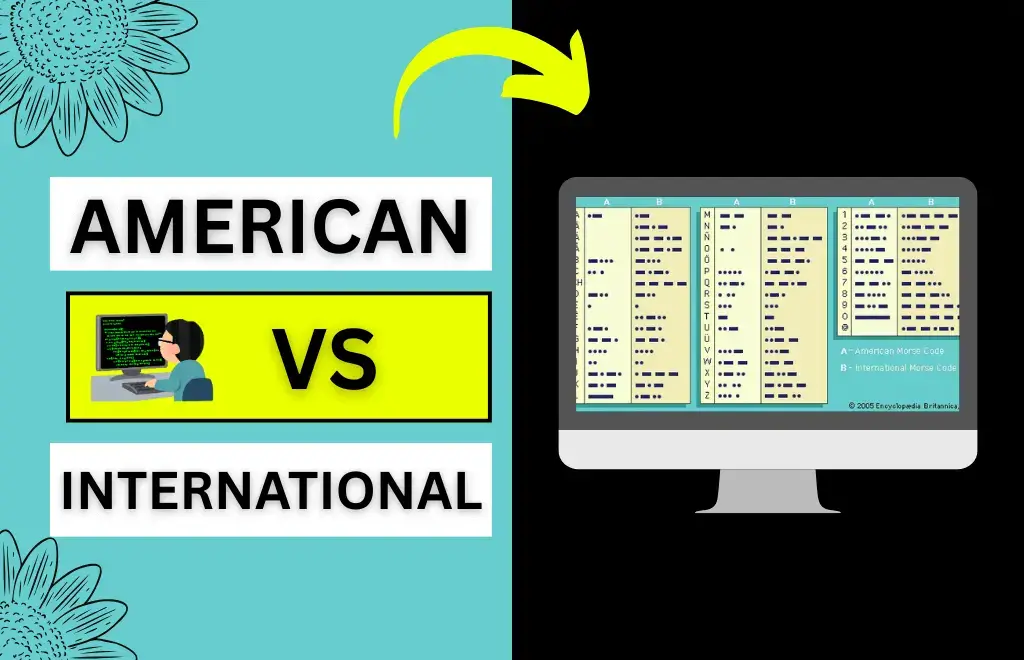
American Morse Code
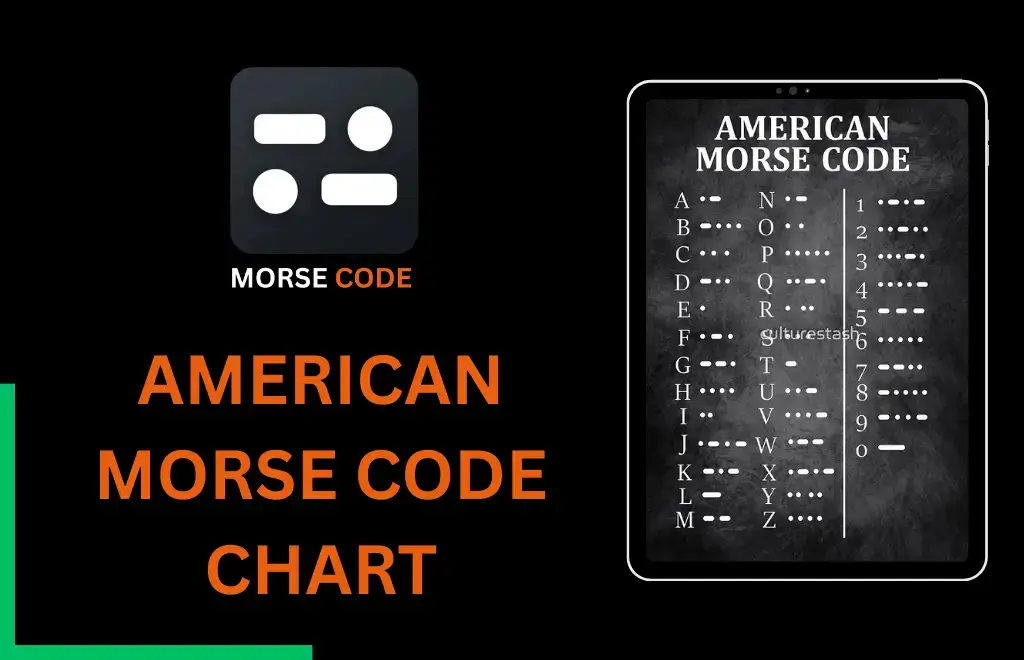
American Morse code, also known as railroad Morse code, is the original version of Morse code developed by Samuel Morse and Alfred Vail in the mid-1840s for the early telegraph systems in the United States. The first message transmitted from this version was “What hath God wrought?”. Moreover, you can use our American Morse code translator to learn this version of the code.
American Morse code is quite difficult to understand, as it employs a complex system of dots and dashes. Its complexity makes it difficult to transmit the message and produces errors. It was frequently used when the telegraph was not advanced, but once the technology developed, this slower version became limited and eventually extinct. However, this American version can often be seen in American railroad museums and at Civil War reenactments in the United States.
Features of the American Version
Here are all the features of this version of Morse code:
- It uses a short mark or dot (.)
- It uses long marks or dashes (-)
- It uses a long dash.
- It contains a standard gap between characters.
- It contains a long gap between these characters: C, O, R, Y, Z, and &.
- It contains a short gap between letters.
- It contains a medium gap between words.
- It contains a long gap between sentences.
- It uses a longer dash for the digit 0.
International Morse Code
International Morse code, also known as Continental Morse code, is a modified version of the original Morse code developed by Clemens Gerke to enhance its reliability and efficiency. It was introduced slightly later than the American version in 1848, but in 1865, the ITU (International Telegraph Union) adopted it, considering it a superior version of Morse code. Later, it was adopted worldwide and set as a standard. It uses a standardized set of symbols for letters, numbers, punctuation, and prosigns, which makes it less complex and easier to understand.
International Morse code is simple to learn, teach, and transmit. You can easily communicate the message through various communication systems, including sound, light, and radio waves. Furthermore, you can also use our international Morse code translator for encoding and decoding purposes. It’s widely used today and is used in sending emergency messages such as SOS distress signals. Not only that, this version can also be seen in military operations, aviation, and radio operators.
Features of the International Version
Here are all the features of the international version of Morse code:
- It uses a short mark or dot (.)
- It uses a long mark or dash (-)
- It contains a standard gap within a single character.
- It contains a short gap between letters.
- It contains a medium gap between words.

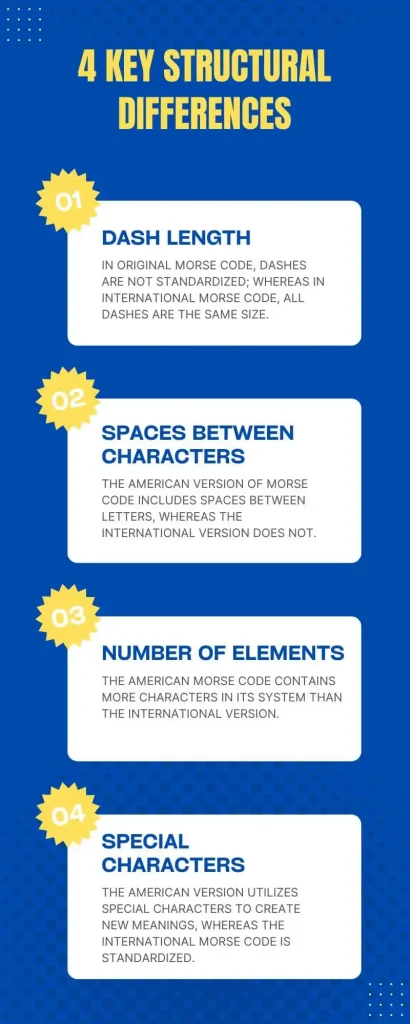
Structural Differences
Below are all the structural differences between the two Morse code versions:
- Dash length: In original Morse code, dashes are not standardized, as some are short and some are long; whereas in international Morse code, all dashes are the same size. For instance, the letter L in the American version is represented by a long dash, and in the international version, the length of a dash is uniform.
- Spaces between characters: The American version of Morse code includes spaces between letters, whereas the international version does not.
- Number of elements: The American Morse code contains more characters in its system than the International version.
- Special characters: The American version utilizes special characters to create new meanings, whereas the international Morse code is standardized, making it easier to learn and use.
American Morse Code vs International Morse Code
We’ve provided a table below that features all the major differences between the two Morse code versions:
American | International |
|---|---|
Introduced in 1844 | Introduced in 1848 |
Also known as the Railroad | Also known as Continental Morse code |
Uses a complex system of codes | Uses a less complex system and standard length for easy encoding and decoding |
Difficult to learn | Easy to learn |
Perfect for early telegraphs | Accepted worldwide because of its accurate transmission |
It’s rarely used today | It’s widely used today |
FAQs
Conclusion
As we reach the end of the article, I can confidently say that now you’re well-equipped with everything you need to know about American Morse code vs International Morse code. The main differences between them lie in the length of the dashes, the spacing between characters, the number of elements, and the use of special characters. Furthermore, the American version is more difficult to learn and transmit, as it employs a complex system of code. In contrast, the international version is less complicated and can be easily memorized and transmitted.
